

VIRGINIA’S NEW CHILD SUPPORT GUIDELINES
Brian M. Hirsch, Esquire
New child support guidelines go into effect on July 1, 2025, amending the charts in Virginia Code § 20-108.2. The guidelines had not been increased since 2014. According to Senator Scott Surovell, the bill’s sponsor, The Virginia Department of Social Services engaged the Center Policy Research, an expert in economic analysis for state child support guidelines, to review the then-current guidelines. Their research revealed that, among other things, childrearing expenses and inflation have increased substantially since 2014, justifying an increase to the guidelines.
In certain cases, the new guidelines are substantially higher than the previous ones. Consider a few scenarios. Below is the basic fact pattern for Scenario 1.
- The parties have two minor children,
- Father has 130 days per year and mother has 235 days per year,
- Father works fulltime for $7,500 per month (e., $90,000 per year),
- Mother works part-time for $3,500 per month (e., $42,000 per year),
- Father pays mother $500 per month spousal support,
- Father provides health insurance for the children for $350 per month, and
- Mother pays $600 per month for childcare.
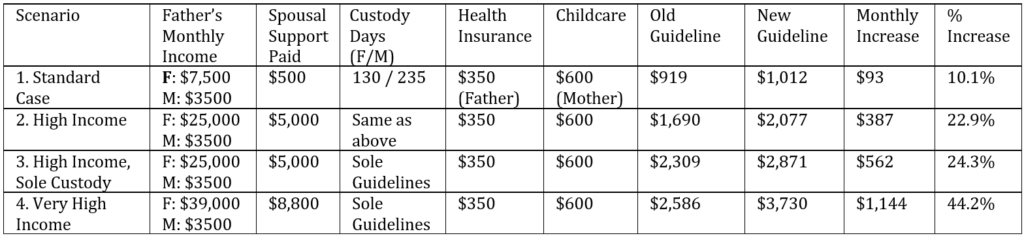
Under the old guidelines, father would pay mother $919 per month. However, using these same numbers for the new child support guidelines, father would pay mother $1,012 per month, an increase of $93 per month or $1,116 per year.
For Scenario 2, if you increase father’s income to $25,000 per month and spousal support to $5,000 per month but keep the rest of the facts the same, the difference is more pronounced. Under the old guidelines, the child support would be $1,690 but is $2,077 under the new guidelines, an increase of $387 per month or $4,644 per year.
For Scenario 3, if father had 90 days or less per year (i.e., not shared), then child support would be $2,309 per month under the old guidelines and $2,871 under the new guidelines, an increase of $562 per month or $6,744 per year.
For Scenario 4, using the last example but increasing father’s income to $39,000 per month and spousal support to $8,800 per month, child support is $2,586 under the old guidelines and $3,730 under the new guidelines. This is a difference of $1,144 per month or a 44.2% overall increase. The table below summarizes the four scenarios.
Comparison Table: Old vs. New Child Support Guidelines (Effective July 1, 2025)[i]
The new guideline chart also extends to a combined gross income of $42,500 per month (or $510,000 per year) before it switches over to the chart with lower percentages. Under the old guidelines, the switch to the lower percentages occurred at $35,000 per month (or $420,000 per year). So, parties with a combined gross income between $35,000 and $42,500 per year will likely see a disproportionate increase in support.
Noteworthy is that under Milligan v. Milligan, 12 Va. App. 982, 407 S.E.2d 702 (1991), a change to the child support guidelines might, in and of itself, be considered a material change in circumstances. In Milligan, the ex-wife filed a petition to increase child support two years after the parties set child support in their marital settlement agreement and a divorce was granted. Afterward, the General Assembly adopted new child support guidelines. The trial court denied the ex-wife’s petition, holding that she failed to prove a material change in circumstances which would justify an increase in child support. In reversing the trial court, the Court of Appeals held that it is not a condition precedent to a party obtaining the benefit of the new guidelines if the petitioning party “can show a significant variance between the guidelines and the court’s prior decree.” Id. at 988. See also, Slonka v. Pennline, 17 Va. App. 662, 440 S.E.2d 423 (1994), and Ford v. Johansen, 17 Vap UNP 1125162 (2017). So, even if nothing significant has changed in the parties’ situation since the entry of the last child support order, a party can prevail on a motion to modify child support if there is a significant variance between the two guideline amounts.
The real question becomes what a trial court will consider a “significant variance.” In the Scenario 1, is a $93 per month increase from $919 to $1,012 significant? It’s only a 10.1% difference, but it could feel significant to the recipient. On the other hand, in Scenario 3, child support goes from $2,309 per month under the old guidelines to $2,871 under the new guidelines, an increase of $562 per month or 24.3%. Presumably, a court would consider this a significant variance between the two support amounts. If you do not have access to a program to run the new guidelines, they can be found on the Division of Child Support Enforcement’s website at: https://virginiachildsupportcalculator.com. Nanda Davis put together a website with the old and new guidelines at https://www.senita.legal/.
Calculating child support arrearages can be a little tricky for cases filed prior to July 1, 2025 but adjudicated or settled afterward. Virginia Code § 20-108.1(B) provides, in relevant part, that “[l]iability for support shall be determined retroactively for the period measured from the date that the proceeding was commenced by the filing of an action with any court . . . .” So, the old child support guidelines should be used to calculate any arrearage prior to July 1, 2025 and the new guidelines should be used to calculate any child support arrearage from July 1, 2025 forward. See, Cooke v. Cooke, 23 Va. App. 60, 474 S.E.2d 159 (1996) (“ . . . trial courts may not retroactively apply amended guidelines to fix awards for periods governed by prior guidelines, absent written findings justifying a departure from the former statute.”)
Given the investment of the client’s time and money, practicality should govern in approaching these cases. Also, filing a petition can often have a negative impact on the parties’ parenting relationship. Is an increase of only $163 for children who are 15 and 17 really worth filing a motion to increase child support, issuing discovery and having a hearing? On the other hand, a difference in $527 for children who are 8 and 11 might be. As is often the case in matters of child support, a negotiated or mediated resolution is the path of lower cost and conflict for the parties.
[i] Thanks to Mitchell Broudy, Sr. Assistant Attorney General, Eastern Virginia Regional Legal Division, Division of Child Support Enforcement, for assembling this chart.